
Federal Apostille Services
Federal Apostille Services: We assist with obtaining apostilles for eligible U.S. federal documents, including FBI background checks and other documents issued by federal agencies for international use. Our streamlined process helps ensure your documents are properly prepared and submitted, saving you time while providing reliable, professional support every step of the way.

What Is a Federal Apostille?
Authentication for Federally Issued Documents
A federal apostille is a certificate used to authenticate an eligible document signed or issued by a U.S. federal official for use in a Hague Convention country.
The apostille verifies the authenticity of the official signature, the capacity in which the official acted, and the seal or stamp appearing on the document. It does not verify the accuracy or legal effect of the document’s contents.
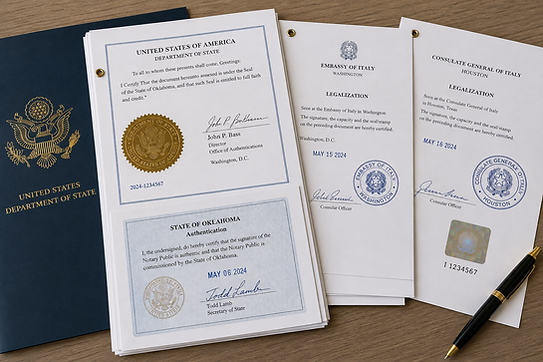
For documents intended for countries outside the Hague Convention, a federal certificate of authentication may be required instead, followed in some cases by embassy or consulate legalization.
Federal Apostille vs. State Apostille
Understanding the Difference
Federal Apostille
Typically applies to eligible documents issued or signed by:
-
U.S. federal agencies
-
U.S. federal officials
-
Federal courts
-
U.S. consular officers
-
Certain military officials
State Apostille
Typically applies to documents issued or notarized within a particular state, including:
-
State vital records
-
State court records
-
State-issued business documents
-
Locally notarized affidavits
-
Powers of attorney
-
School records
-
State background checks
A federally issued document generally follows a federal process, while a state-issued or state-notarized document is usually submitted to the appropriate state authority.

Eligible Federal Documents May Include
-
FBI background checks
-
Federal court documents
-
Certificates of Naturalization
-
U.S. Department of Agriculture documents
-
Animal and plant health certificates
-
Certificates of Pharmaceutical Product
-
FDA-issued documents
-
U.S. Patent and Trademark Office records
-
IRS tax-residency certifications
-
Social Security Administration documents
-
Environmental Protection Agency documents
-
Office of Personnel Management records
-
Documents issued by other eligible federal agencies
Federal Document Services
-
Document Review
-
We review the document type, issuing agency, destination country, and available signatures or seals to help identify the appropriate process.
-
Submission Preparation
-
We help organize the required documents, request form, payment, and return-delivery materials.
-
Federal Apostille Processing
-
We coordinate submission of eligible documents for use in countries participating in the Hague Apostille Convention.
-
Federal Authentication
-
We assist with certificates of authentication for documents intended for non-Hague countries.
-
Embassy and Consulate Legalization
-
When required, we can help coordinate additional legalization through the destination country’s embassy or consulate.
-
Certified Translation Coordination
-
Certified translation services are available when documents must be translated for use abroad.
-
Secure Return Delivery
-
Completed documents can be returned through an agreed-upon tracked delivery method.

Information Required to Begin
Please be prepared to provide:
-
Your full name and contact information
-
Type of federal document
-
Name of the issuing agency
-
Destination country
-
Number of documents
-
Intended use
-
Deadline
-
Translation requirements
-
Return-shipping preference
-
Any instructions from the receiving organization
Federal Apostilles for FBI Background Checks
FBI identity history summaries are among the most frequently processed federal documents for international use. They may be requested for:
-
Foreign employment
-
Residency applications
-
Visas
-
International adoption
-
Teaching abroad
-
Dual citizenship
-
Immigration matters
-
Professional licensing
-
Overseas business requirements
The destination country should always be identified before submission because it determines whether an apostille or authentication certificate is appropriate.
Avoid Unnecessary Delays
Federal documents generally must meet specific preparation requirements before they are submitted. Depending on the document, this may include:
-
An original or eligible certified copy
-
An original official signature
-
The printed name and title of the signing official
-
An official agency seal
-
A date of issuance
-
Federal agency letterhead
-
Identification of the destination country
-
The U.S. Department of State warns that federal documents should not be notarized merely to prepare them for federal authentication, because doing so may make the document unacceptable.
A Simple Step-by-Step Process
1
Tell Us About Your Document
Provide the document type, issuing federal agency, destination country, number of documents, and deadline.
2
We Review the Requirements
We determine whether the document appears to require a federal apostille, authentication certificate, additional legalization, or translation.
3
Prepare the Submission
The submission may include the original or eligible certified document, the current federal request form, applicable fees, and return-delivery materials.
4
Federal
Processing
The request is submitted to the appropriate federal authentication office.
5
Additional Legalization,
When Needed
Documents for certain non-Hague countries may need further processing through an embassy or consulate.
6
Receive Your Documents
Completed documents are returned using the selected delivery method.
What is the difference between a federal apostille and authentication?
Frequently Asked Questions
A federal apostille is generally used for an eligible federal document going to a Hague Convention country. A certificate of authentication is generally used for a non-Hague country and may need additional embassy or consulate legalization.
Can the Oklahoma Secretary of State apostille an FBI background check?
An FBI background check is a federal document and generally follows the federal authentication process rather than a state apostille process.
Does my federal document need to be notarized?
Usually, a federally issued document should not be notarized simply for authentication. It should generally contain the proper federal official’s signature and agency credentials.
Can you process a photocopy?
Federal authorities may require an original or eligible certified copy with original seals and signatures. Ordinary photocopies may not be accepted.
How long does federal processing take?
Processing times can change and depend on the submission method and federal workload. The Office of Authentications publishes current processing information, so clients should allow sufficient time before travel, immigration, employment, or filing deadlines.
Is embassy legalization always required?
No. Embassy or consulate legalization is generally associated with documents intended for countries that do not use the Hague apostille process. Requirements vary by country.
Can you help with certified translations?
Yes. Translation coordination is available when the receiving country or organization requires a certified translation.
Do you provide legal or immigration advice?
No. We assist with document processing and notarization services but do not provide legal, immigration, or government-agency advice.
Serving Oklahoma City & Surrounding Communities
Affluent Mobile Notary & Apostille proudly provides professional document services throughout Oklahoma City and surrounding cities and counties.
Our service area includes:
Oklahoma City • Yukon • Mustang • Edmond • Moore • Norman • Piedmont • Bethany • Warr Acres • Midwest City • Del City • Nichols Hills • The Village • Choctaw • Harrah • Newcastle • Blanchard
We serve clients throughout areas of Oklahoma County, Canadian County, Cleveland County, Logan County, and surrounding counties, depending on the requested service, appointment location, and availability.
If you are outside our primary mobile service area, contact us to discuss your needs. Remote Online Notary services may provide an alternative when an in-person appointment is not necessary or practical.